David Annwn
interviewed by Gregory Vincent St. Thomasino
“Every film is a storm of signifiers, many of which, whatever the director’s intentions, they are powerless to control.”
— David Annwn
Do you have a favorite director?
My shocked devotion to directors tends to change over time and attaches to several of their films rather than their whole career. I saw Carol Reed’s ‘The Third Man’ again the other day and all my wonder at the seamless interplay of the amazing camera-work, jolting script, the small interruptions to each early scene to deepen the sense of hasty confusion, the deeply engaging music surfaced again. Powell and Pressburger’s ‘A Canterbury Tale’, Fellini’s ‘Amacord’, Kurosawa, Ford’s (I hate his politics) ‘The Searchers’; a handful of Hitchcocks; my favourite folk horror film is Pieter Van Heess’s 2008 little-known ‘Linkeroever’ /‘Left Bank’ with its authentic knowledge of ritual history, the bog burials, the archer guilds, its beautifully-building dread and the way he writes a genuine pagan conclusion, turning ‘The Wicker Man’ on its nasty, nihilistic head. Pieter and I write to each other. He says that one of my letters was one of those he had waited all his life to receive. I know nothing about Natalie Erika James but her extremely brief ‘Drum Wave’ (2018) is a master-class of restraint, Japanese fertility rituals and songs, intense detail and open-endedness in recent folk horror. It has almost come and gone before you realise what you have just witnessed. It reveals the bold, minimal strokes that a good horror director can use. Free to view on the Internet.
Powell and Pressburger, A Canterbury Tale, I first saw this with my wife-to-be some forty years ago in an art house in Greenwich Village and I said to her afterwards I thought the glue in the hair was erotic and she agreed. I am aware of the folk horror genre and I know of the book Folk Horror on Film: Return of the British Repressed. I have a Wicker Man set that came in a wooden box. It’s striking how the Sergeant Howie character is nearly driven to madness in his resistance to sex out of wedlock, and ironic how in this resistance he thus verifies himself worthy to be sacrificed (to be martyred).
I certainly see what you mean about the glue in the hair. When I first saw ‘A Canterbury Tale’ part of what appealed was the mysticism associated with the landscape : that extraordinary scene where the covert glue-thrower lies hidden in the pale grasses while the sitting couple talk on the hill. It is, for me, both eerie and lyrical — with the grasses left to sway in the silence. As if the hill itself listens. A little reminiscent of the novels of John Cowper Powys but all with the backdrop of an actual modern war. (That opening shot where the hunting hawk changes into a Spitfire!) There are similar scenes with a mystical sense in Powell and Pressburger’s ‘I Know Where I’m Going’, their Scottish film.
I have to ask this so let me get it out of the way: This is an historic time for Hammer Films and their Dracula (Terence Fisher, 1958), we’re told we will see this film for the first time as its director intended, before the censors got hold of it. I have so far read just one review of it and it does appear there is some new material, what the reviewer, Terry Sherwood, calls “physical horror.” Are you at all excited about this? Is it maybe time for a re-envisaging of Hammer’s Dracula?
Yes, yes, I can’t wait. Fisher and Lee and the whole ensemble let loose on the English Southlands again and with more graphic abandon than already seen! The style: the rhythms of Lee’s body-movements are balletic at times, the palette, Harker’s secret knowledge of who his host really is and the spiritual drive throughout. My recently late and dear friend, David Pinner (author of the novel ‘Ritual’ foundational for ‘The Wicker Man’) met and had a great affection for Lee. A charming and elegant if rather right-wing man. Lee frightened my childhood viewing to bits. His transformation from urbane Englishman gentleman to feral raptor is magnetic/repulsive and that is presumably what fascinated Byron/Polidori about that archetype’s transformation. What a good idea about ‘Re-envisaging Hammer’—I’d love the time and energy to write that but Hammer has her far more able and ready aficionados. My first horror film was ‘The Curse of the Mummy’s Tomb’ (1964). I never recovered from the hand-amputations in that film shown with dreadful and complacent aplomb.
Lee can, and does, come off as haughty. In his autobiography, Tall, Dark and Gruesome, he says his father (where he got the name “Lee”) left his mother when he was four and he was brought up as a Carandini (his mother was the Contessa Estelle Marie Carandini). He writes: “The Carandinis, one of the six ‘black’ families of papal nobility in Italy, trace their origins back to imperial Rome.” And also he is so tall and he has that great deep voice. Lee, beyond having the prestige of being a Bond villain, has gained whole new generations of fans such as with the Lord of the Rings trilogy. And he’s bringing new fans to Hammer!
That link to the Caradinis would perhaps explain why he agreed to take part in Italian horror and Gothic films so readily. He explained to my friend, David, that he felt rather enclosed by socialists when he worked with British film crews (though I find that hard to imagine at Hammer studios.) He felt isolated in his Conservative views. Yes, ‘Lord of the Rings’ — he did well in those films and regarded them as some of his best. I think he really enjoyed playing up to Ian McKellen’s Gandalf — an interesting confrontation in acting terms. Though one must add that, politically, they were poles apart. I always remember that Lee was intensely kind to Peter Cushing after Peter’s wife died — encouraging him to act with him in further films.
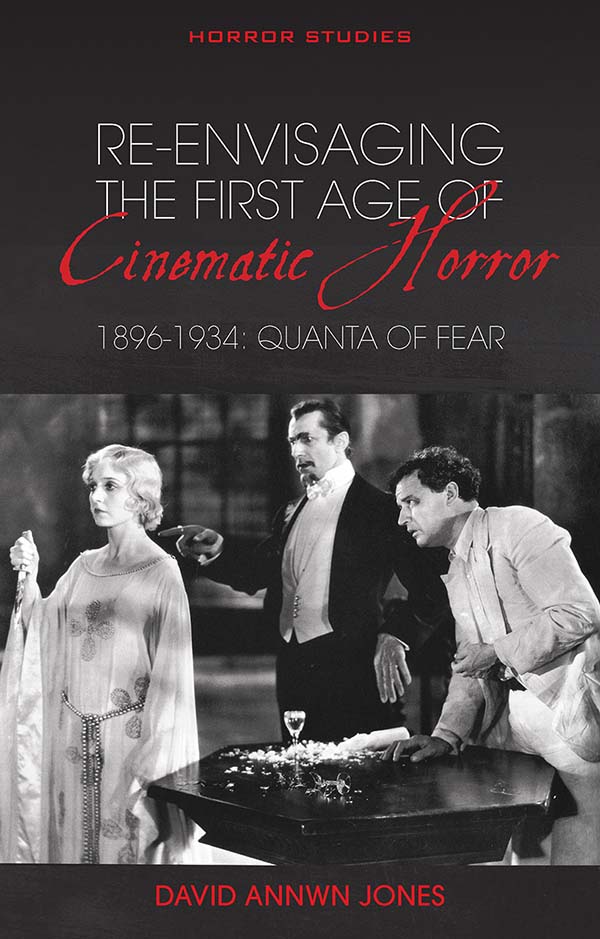
“Physical horror” . . . quanta of fear? With your 2018 study Re-Envisaging the First Age of Cinematic Horror 1896-1934: Quanta of Fear, which we read is part of a new book series dedicated to the study of the genre called, Horror Studies, you have become known as the scholar who has applied quantum field theory to cinematic horror. I ask: Are we strictly in the realm of metaphor here, or . . . ? But first, you open your study with an important point: These “horror” or as otherwise termed “cinema of attractions” films were made before there was a genre identified as “horror,” before there was a horror genre.
Yes, in my opinion, critics who fasten onto a few clunky generic features in order to establish the American films of the early 1930s as the start of the ‘horror’ category per se are fastening upon an impoverished vision of cinema and ignoring the second part of Murnau’s ‘Nosferatu’ title and the statements by pre-1930 American (and other) movie reviewers. I re-watched the newly-discovered first reel of Charles Calvert’s ‘The Avengjng Hand’ (1915) on the Internet recently in response to this question. One cannot drive a wedge between this film (and its visual data, shifts, acting etc) and the Mummy films of the 1930s for example. It is also alive with that which I have called horror quanta, metaphoric and otherwise.
The second part of F.W. Murnau’s Nosferatu title is “a Symphony of Horror” and this was made in 1922, so indeed the concept of “horror” was in force. And with regard to, for example, the Universal films of the thirties, you point out that the filmmakers were drawing on earlier films for their effects, their “horror quanta,” thus relocating “the start of the ‘horror’ category” to an earlier time and place. Do I understand the use of the term “horror quanta” as I am using it here? This idea, the concept, the meaning understood in the word “horror,” was it the same for Murnau as for Tod Browning and James Whale and Karl Freund and as for, say, Terence Fisher, or did they inherit it whole? You point out Lee’s body-movements are balletic at times (and certainly in Curse of Frankenstein where he is like a marionette), these movements suggest a reference to the more theatrical silent period or to the Universals of the thirties. It’s interesting how Whale’s, and Boris Karloff’s, Frankenstein’s monster is so stiff, the stiffness of death (a rigor mortis)!
American film journal writers refer to these cycles of ‘dark’ films such as ‘Caligari’ and ‘Nosferatu’ as ‘horrors’ well before 1931. That is why I believe that trying to base a horror film genre template on the 1930s Universal horror movies and apply it to previous films is a mistake. Bela Balasz was very forthright on early German horror films — it was a point of pride. Your points on marionettes and stiff body-movements in ‘Frankenstein’ and elsewhere are fascinating. Part of me wonders whether these come from early ‘mummy’ films which started to proliferate round the Fitst World War. Also, we see Olympia the mechanical doll in Richard Oswald’s ‘Tales from Hoffmann’ (1916) and perhaps the robot in Lang’s ‘Metropolis’ with their stiff movements. We can follow this repertoire of movements even further back to magic lantern shows and actual puppet-shows. Incidentally, I do think quite a lot of my knowledge of early silent horror films is predicated on my experience of being a magic lanternist who has mounted his own phantasmagoria shows with actual Victorian slides and also my research into E.G. Robertson’s famous Parisian phantasmagoria shows.
Help me out of the weeds here: I want to consider the “cinematic quanta” (the fear-inducing cinematic quanta) with regard to the idea of randomness, (where, let us say, “randomness” is the absence of a pattern), how while with regard to certain avant-garde films randomness is a deliberate strategy, with regard to the films in question (certainly perhaps the first forty years, but arguably across periods) randomness may show up as the illusion of randomness (in distinction to the absence of a pattern, here it is a principle of organization, an intelligent design), but otherwise the dialectic between both spectacle and narrative is quite deliberately paced and planned, indeed it is scripted, an example would be the jump scare which if successful ought to seem random, but is actually directed. How do you sort out the ideas of quantum field theory (and such as randomness) with regard to an object that is so intelligently designed as to deliver its attractions?
It’s a great question. As you write, good directors build in or incorporate the sense of randomness into their films so these are, in effect, elements of design. I think randomness then emerges in two other ways as opposed to this kind of design. Reed did not at all ‘design’ the gust that blew down the few random leaves in the long tracking shot at the end of ‘The Third Man’. It just happened at that moment of filming and this small detail spread a sense of human transience through the whole work. Now you could say that manifests ‘design’ because Reed retained that in the finished film. My other type of randomness is the concept that cinema is not director/crew/celluloid/projection. For myself, there is no cinema without audience as collaborative agency. Whatever Hitchcock thought, he could not know how every single stimulus he placed in his movies affected a watcher. He certainly could not know how every single (some unconscious and inherent to the sets/shots) detail in between those planted stimuli affected each watcher. To this extent and in many other ways, I feel Intentionalism is a deeply-flawed approach. I am saying that each director has no idea of the exact series of ‘jumps’ or dreads their imagery evokes in a varied audience. To that extent, they must see that (and not just in that way), in the act of projection, design flows into randomness (or what they/we can only perceive as randomness). I hope this makes some sense.
It makes a lot of sense. The artist, and so too the scholar, knows that in the creation of the artwork there may occur many fortuitous or by chance elements, and that the artist must be present to these occurrences—they are a gift, and he is right to exploit them, to retain them. The concept of the audience as collaborative agency—although methinks it better accepted in film than in, say, poetry where some readers, and editors, resist doing their natural collaborative agency (in a word, receptivity) beyond the rudimentary reading comprehension. Still, I must ask, in the horror film especially, what constitutes “collaborative agency”?
I agree with what you say about poetry and film in this regard. You ask about what constitutes ‘collaborative agency’ in watching a film. It’s a very complex question. Granted, films are (partly) immersive experiences. Additionally, I’ve been writing a long study of Robert Eggers’ ‘Nosferatu’ and so watching the film, and sections of it several times over. It is really striking (to myself) that in my first collaborative viewing of this film I projected quite a collection of visual sensations. For example in the scene where Thomas arrives at the cross-roads before Orlok’s castle, I perceived the aerial shot which filled the screen as a dense tapestry. I almost felt I could step forward and touch it. (Now that was certainly an image which I supplied as a member of the audience.) The other thing I noticed in repeated re-viewing was how much detail I had missed earlier in my first viewing in the cinema. There is at least, I would suggest, one hidden film-within-the-film of which I was totally oblivious first time through. So I guess both of those examples say something about the nature of film-viewer collaboration.
Robert Eggers’ Nosteratu, the art direction is something to behold, it’s the star of the film, no sarcasm intended. Did you see this in 4K? Any love for Werner Herzog’s Nosferatu the Vampyre (1979)? Klaus Kinski? 4K? What do you think of this process as it adds depth to films, even to some films where the director never thought in such terms. Sometimes I find it a little disconcerting, in the sense that instead of bringing me further into the film it distracts me such that I am not so much absorbed into the action as making a judgment about how the movie looks.
Well, the Web tells me that the Eggers wasn’t shown in 4K in British cinemas so that ‘touching-the-tapestry’ moment I had must have just been part of his 35mm effects — pretty dense as they were. I do like the Herzog and Kinski very much, though it’s hard to scream (or think about it) when you’re laughing! (That scene with the clock is a hoot enough for owls.) Overall, I agree with what you say about 4K as I don’t like to think about format when I’m ‘losing’ myself in film. Though I did enjoy the impact, when it first came out, of watching the 70mm ‘Heaven’s Gate’ on the huge IMAX screen in Bradford. An actress was seen bathing in a lake in front of a mountain which seemed literally as big as a mountain. Ah! I can be taken willing captive by such tricks of scale.
“Tricks of scale.” 70 mm. The Searchers was shot in “Vistavision.” Scope. The IMAX format. These techhnologies deliver spectacle, the attractions are the grand vistas and in the case of, say, Cinerama it’s the technology itself, Abel Gance’s Polyvision, the three-projector format for Napoléon (1927), these in distinction to the attractions of the first age of cinematic horror, which are transgressive, subversive. My concern is how technologies reform, dictate (?), the cinema experience. I suppose one can argue that, say, “golden hour” cinematography is a technology, but the poet in me wants to liken it to that randomness that graced Reed’s final scene, I mean in the sense that you have to be present to it. I think the IMAX format is great for a Godzilla movie (or even for the rooftop concert, which after all was a spectacle to begin with), but would seeing White Zombie or The Black Cat in IMAX make it any more, uh. enjoyable (aside from a better appreciation of the art direction, no sarcasm intended)?
And none at all inferred, Gregory. I like myriad kinds of random-ness that emerge during filming as in the Reed ‘Third Man’ sense but seeing ‘White Zombie’ or ‘The Black Cat’ in IMAX would not at all enhance our viewing experience (in my opinion). This is because the directors and makers of these films imagined them, prepared them, framed them and shot them within the format of the film at their disposal. Now, as I say above, I’m not an Intentionalist who believes we — as an audience — should be seeking out the director’s intentions. The film should be a released presence with its own multi-valencies for us to explore at large. Yet, having said that, at the very least, the film should set out manifesting a vision or visions and format as part of that vision/those visions and en-visioning. This is why those multi-media immersive events that sensationally take us inside installations of Van Gogh or Cezanne paintings (though not wrong) are completely missing the point. The medium is still the message. Van Gogh and Cezanne (usually — though there are exceptions) chose where to cut off and frame their paintings and that is the part of the impact of the work’s conveyance. Dilute that and it’s something very different. The same with Weimar movies shown in IMAX. So when you write: ‘My concern is how technologies reform, dictate (?), the cinema experience,’ I share that concern. Dictation in some cases and a range of influences in others. Just something as simple as thinking of a version of ‘Jaws’ for some reason projected in black and white (when we remember Spielberg’s attention to palette), should show how strong and transformative these influences can be.
fall 2026
David Annwn is the author of 14 books of poetry and is well known for his collaborations with celebrated American calligrapher Thomas Ingmire and his Gothic and Film critical studies. In August 2026, he presented his literary archive to the National Library of Wales, a rare honor for a living author.